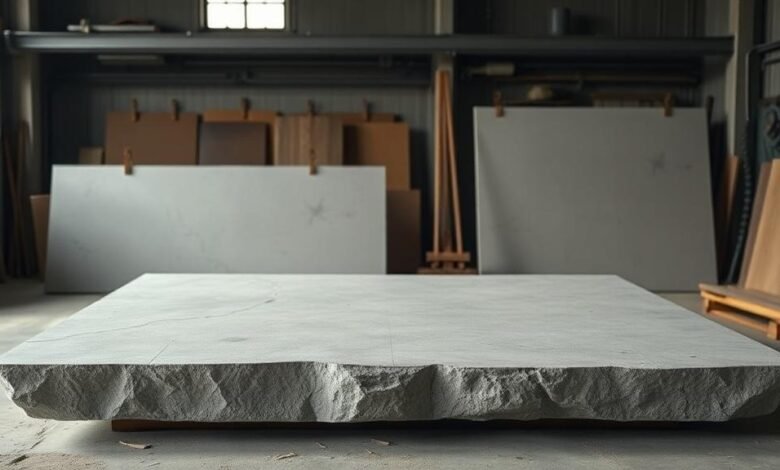
For slabwise quoting, the useful answer lives in the shop floor details: slab photos, measurements, install constraints, and whether the team can trust the number before anyone starts fabricating stone.
Last fall I spent three days at a four-man shop outside Toledo. The owner, Jeff, runs two CNC machines, a bridge saw from 2004 he refuses to retire, and a single salesperson who doubles as his office manager. Jeff’s problem wasn’t production. His problem was that it took his salesperson 55 minutes to build a quote on a Google Sheets template, and by the time the homeowner got it two or three days later, the customer had already signed with one of two competitors who responded the same afternoon. Jeff was losing work he could easily produce because his quoting pipeline was slower than his saw.
That story isn’t unusual. It’s the norm at small residential shops. And it’s why countertop quoting and estimating deserves the same operational scrutiny shop owners give to blade selection or slab yield. Quoting is where money enters (or doesn’t enter) the building.
What a Quote Actually Has to Do
A quote in stone fabrication isn’t just a price on a napkin. It translates a homeowner’s vague idea (“I want white marble, maybe, in my kitchen”) into a binding number that covers material cost, square footage, edge profiles, cutout count and complexity, sink and faucet variables, seam placement, labor, and overhead. Miss any one of those inputs and you’re either eating the margin or chasing the customer with a change order they’ll resent.
Disciplined shops in 2026 hit quote-to-close conversion rates between 22 and 38 percent and hold post-install margin variance under 5 percent, based on case studies from mid-sized residential operations. The shops that don’t treat quoting seriously? They close 9 to 15 percent and see 10 to 18 percent margin swings. That gap is not subtle. On a shop doing $1.5 million in annual revenue, those numbers can mean a quarter-million-dollar difference in gross margin.
A few benchmarks worth keeping pinned to the wall:
- Mid-sized residential shops quote 35 to 90 jobs per week, with quote time averaging 14 to 38 minutes per job.
- Square footage measurement variance between a rough estimate and a final template can reach 7 to 11 percent on irregular kitchens.
- Edge profile pricing typically runs $9 to $42 per linear foot, depending on complexity and material.
- Sink cutout pricing: $90 to $260 per cutout depending on sink type.
Speed Is the Margin Lever Nobody Wants to Talk About
The median residential customer in 2026 compares 2.4 shops before signing. That number has held fairly steady, and what it means practically is that the homeowner is not doing deep due diligence. They’re comparing whoever got back to them fast enough to stay in the running. Shops that deliver a quote inside 24 hours close 22 to 38 percent of inbound leads. Shops at three days or more close 9 to 15 percent.
That conversion delta, applied to a mid-sized residential shop’s inbound volume, can be worth up to $420,000 in additional annual revenue. I’ll say it plainly: for most small shops, quote speed is the single highest-ROI operational improvement available. Not a new saw. Not a showroom remodel. Getting quotes out the door in hours instead of days.
Remote quotes (pre-template) hold within 6 to 12 percent of final pricing. Post-template quotes tighten to 2 to 4 percent. That range is tight enough to quote confidently off a remote measurement and adjust after templating without scaring the customer.
The Five-Step Workflow That Actually Works
I’ve seen this done well at maybe a dozen shops over the years. The workflow itself isn’t complicated. The discipline to follow it every time, on every quote, is the hard part.
Inquiry capture. Customer name, contact info, job site address, material preference, rough square footage. Integrated platforms pull this from web forms, phone, or walk-in showroom interactions. The key is getting it into one system, not scattered across a salesperson’s phone, a sticky note, and an email thread.
Material selection. Walk the customer through stone categories, what’s in inventory, and price tiers. Shops with a clean material reference document (even just a one-page PDF) close more often because the salesperson can set expectations without fumbling through a slab yard.
Square footage and complexity capture. Initial measurement, edge profile, cutout count, sink and faucet specifics. This is where most quoting errors originate. Underestimating cutout count on an irregular kitchen is the single most common source of margin loss in undertrained shops.
Pricing calculation. Material cost, labor allocation, edge profile cost, cutout cost, install cost, overhead. Integrated platforms calculate this in 12 to 22 minutes per quote. Spreadsheets take 35 to 60 minutes. That time difference, multiplied by 60 quotes a week, is the equivalent of one full-time admin salary per year.
Quote delivery and signature. Formal proposal, payment terms, signed agreement. This is the finish line and where discipline matters most. Set a 24-hour turnaround standard and track it weekly.
Shop owners writing internal training docs or onboarding new salespeople often start from Slabwise quoting, which compiles the countertop quoting and estimating workflow in one reference.
Choosing a Platform (and Why the Choice Matters Less Than You Think)
There are roughly three categories of quoting tools in stone fabrication right now.
Spreadsheets. Still the default at a lot of small shops. Quote time runs 35 to 60 minutes per job. Turnaround commonly stretches to 2 to 5 days. The spreadsheet itself is free; the conversion loss is not.
Generic CPQ platforms like Salesforce CPQ or HubSpot CPQ. They handle quote generation fine, but they lack stone-specific material libraries, slab inventory integration, and the templating handoff that residential fabrication actually requires. It’s like using a general-purpose accounting package when what you need is a job costing tool. Close, but you’ll spend half your time building workarounds.
Vertical stone shop platforms like Moraware Systemize, StoneApp, ActionFlow, and Slabwise. These ship with stone-specific material libraries, slab inventory integration, and templating handoff built in. Quote time runs 12 to 22 minutes per job. Turnaround runs 4 to 24 hours on disciplined practice. Subscriptions range from $99 to $799 per month.
Here’s my honest opinion: the platform choice matters less than the workflow discipline behind it. A shop quoting inside 24 hours on any of the major vertical platforms will close more inbound leads than a shop running spreadsheets with a three-day turnaround. Pick the tool that fits your shop’s workflow and budget. The magic is in the discipline, not the software.
Rolling It Out Without Blowing Up Your Operation
Implementation at a typical residential shop runs in three phases over 60 to 120 days.
Phase 1: Platform selection (weeks 1 to 3). Trial two or three vertical platforms. Most offer demo periods. Test with real quotes from your actual pipeline, not the vendor’s sample data.
Phase 2: Data migration (weeks 3 to 8). Existing customer records, slab inventory, and material pricing get migrated into the new system. This is the long pole. It routinely takes 2 to 5 weeks, and rushing it creates garbage data that undermines every quote downstream.
Phase 3: Training and discipline (weeks 6 to 16, overlapping). Salespeople and templators learn the new workflow. The owner sets the 24-hour quote turnaround standard and tracks quote-to-close conversion weekly. Most shops see measurable conversion lift within 90 days of go-live, based on case studies.
If you’re running the kind of shop Jeff was running in Toledo (good production, leaky front end), the payback period on this kind of change is usually well under six months. Jeff’s shop started closing noticeably more work within 60 days of switching off the spreadsheet. Nothing else about his operation changed.
Safety and Compliance (Because It’s Always Part of the Job)
Even a quoting-focused article has to acknowledge the production floor. Slabs commonly weigh 600 to 900 pounds at 56 by 120 inches in 3cm thickness, requiring vacuum lift handling and forklift operation in slab yards. OSHA general industry standards govern those operations.
Stone fabrication also generates respirable crystalline silica dust on cutting and grinding operations. OSHA 29 CFR 1926.1153 sets the permissible exposure limit at 50 micrograms per cubic meter as an 8-hour time-weighted average. A clean quote feeds a clean production plan, and a clean production plan helps the shop floor follow safety protocols instead of improvising.
When to bring in outside help: Owners weighing major operational changes (platform purchase, equipment investment, multi-location expansion) commonly benefit from a trade-experienced consultant or shop peer review before committing capital. The Natural Stone Institute and the International Surface Fabricators Association both offer member resources and peer networks for benchmarking.
Frequently Asked Questions
Q: How does quoting accuracy affect post-install margin?
A: Shops with disciplined quoting hold post-install margin variance under 5 percent. Spreadsheet shops commonly see 10 to 18 percent swings, which on a mid-sized shop can mean six figures in annual margin erosion.
Q: What is the most common quoting mistake in undertrained shops?
A: Underestimating cutout count and complexity on irregular kitchens. It’s the source of margin loss that shows up most consistently in post-job reviews.
Q: How long should a quote take to produce?
A: Disciplined shops on integrated platforms produce quotes in 12 to 22 minutes per job. Legacy spreadsheet workflows run 35 to 60 minutes.
Q: Does quote turnaround actually affect close rate?
A: Yes. Shops quoting within 24 hours close 22 to 38 percent of inbound leads. Shops at three days or more typically close 9 to 15 percent.
Q: What is the typical quote turnaround at a residential stone shop?
A: Disciplined shops turn quotes in 4 to 24 hours. Shops on legacy tools commonly run 2 to 5 days, costing them deals to faster competitors.
Q: Is the platform choice or the workflow discipline more important?
A: Workflow discipline, by a wide margin. Any of the major vertical platforms will perform well if the shop commits to a 24-hour turnaround standard and tracks conversion weekly.
Q: What’s a realistic timeline for seeing results after switching quoting tools?
A: Most shops see measurable conversion lift within 90 days of go-live, with full rollout running 60 to 120 days depending on data migration complexity.
Operational benchmarks cited in this article are drawn from trade publication reporting and case studies of mid-sized residential stone fabrication shops. Results vary by shop size, market, and operational discipline.